[PROJECT_LOG] // fingerspelling interface
ASL SOHA
A ROBOTIC HAND THAT SPELLS.
Twelve servos, a 3D-printed hand, and a laptop watching through a webcam — learning to read and produce the static handshapes of ASL fingerspelling. Built by four students at Wakeland High School working toward making ASL easier to learn and practice for everyone. Everything about the build lives below.

[MISSION]
ASL fingerspelling is hard to practice alone — there's no immediate feedback, and no one signing back. We're building a physical, two-way tutor that reads your handshapes and forms its own, so both Deaf and hearing people have a hands-on way to learn and practice ASL — not just a classifier on a screen.
[OPERATING MODES]
You sign. It checks.
The screen shows a target letter. The webcam watches your hand through MediaPipe, scores your handshape against the reference, and confirms a correct sign.
It signs. You read.
The robot hand forms a letter using its twelve servos. You type the English letter you think it's signing — training receptive fingerspelling recognition.
[SYSTEM OVERVIEW]
ABOUT THE BUILD
A 3D-printed robotic hand that reads and produces static ASL fingerspelling handshapes in real time — driven by a twelve-servo actuation system, a Raspberry Pi handling onboard control, and a laptop running Python, MediaPipe, and OpenCV for vision and classification. Every layer of the stack, from the tendon-driven fingers to the landmark-tracking pipeline, was designed to be iterated on quickly, so the system can grow more accurate and more expressive the longer we work on it.
[ORIGIN]
Where the hand came from
We're four students at Wakeland High School working with support from the Carnegie Mellon Robotics Institute, toward a cause we deeply care about: making ASL more approachable to learn, for Deaf and hearing people alike. Our hand is built on DexKit, an open, low-cost dexterous hand platform developed at CMU — a soft, tendon-driven hand cast from foam and covered in an ordinary cotton glove instead of rigid 3D-printed fingers, refined with input from an actual hand surgeon to get the thumb's motion right. That foundation is what let us focus on the harder problem: teaching it to read and spell in ASL.
[FROM RESEARCH RIG TO ASL TUTOR]
Repurposing the platform
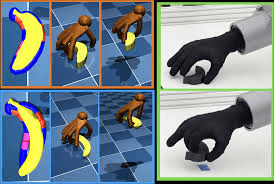
What we possess is the full platform, not just the hand: a 4-degree-of-freedom gantry for positioning, the motor bank driving twelve servos in the hand plus one more for wrist roll, and the soft tendon-driven hand itself. It was designed for dexterous manipulation research — grasping, in-hand repositioning, picking things up. We're pointing that same hardware at a completely different problem: forming and reading static ASL handshapes. Nearly everything downstream of the hardware is ours to build — the vision pipeline, the classification logic, and the two-way tutoring modes that turn a research rig into something people can actually learn ASL from.
[PIPELINE] camera → mediapipe → raspberry pi → servos
Webcam Capture
A standard webcam feeds live video into OpenCV at the laptop, framing the signer's dominant hand.
Landmark Detection
MediaPipe Hands extracts 21 3D landmarks per frame — fingertip and joint positions used to classify the handshape.
Letter Matching
Landmark geometry is compared against reference poses for each static ASL letter to determine a match and confidence score.
Onboard Control
The matched letter is sent to a Raspberry Pi, which decodes it into target angles for each of the twelve servos.
Hand Actuation
Twelve servos drive the 3D-printed fingers into the target handshape, physically forming the letter.
[OPERATING MODES]
The screen displays a target letter. The user signs it in front of the webcam. MediaPipe tracks the attempt and the system confirms whether the handshape matches, letting the user practice producing correct fingerspelling.
The robot hand forms a letter using its servos. The user reads the handshape and types the English letter they believe it represents, training receptive recognition — reading fingerspelling rather than producing it.
[PHOTOS]
[ARCHIVE]
BUILD LOGS
Weekly progress entries — what got built, what broke, what's next. Browse as a list, or scrub through the timeline.
[PERSONNEL]
TEAM
Who we are, and who's behind each part of the build.
Harshil Perla
[ BIO PENDING ] — add a `role` and `bio` for Harshil Perla in content/about.ts.
Oscar Qian
[ BIO PENDING ] — add a `role` and `bio` for Oscar Qian in content/about.ts.
Samarth R
[ BIO PENDING ] — add a `role` and `bio` for Samarth R in content/about.ts.
Anish Kandhi
[ BIO PENDING ] — add a `role` and `bio` for Anish Kandhi in content/about.ts.
[PARTS & REFERENCES]
RESOURCES
Every component, library, and reference that went into this build — what it is, and what it does for the hand.
[ RESOURCES PENDING ] — add entries to content/resources.ts: servos, Raspberry Pi, driver board, 3D-printed hand model/filament, webcam, MediaPipe / OpenCV / Python libraries, and any datasheets or references worth linking.
[CREDITS]
The animated hologram hand in the site background is based on "Hand animation test" by GabrielNeias, licensed under CC Attribution 4.0.